by Deb Jakel
Since the fall of 2018, Kaukauna’s 1000 Islands Environmental Center has worked hand-in-hand with Mulberry Lane Farm to teach important lessons to nature center visitors. While 1000 Islands has the capability to bring invasive species awareness to the citizens of the Fox Valley and surrounding areas, Farmer Pat of Mulberry Lane Farm in Hilbert has the resources to make an impact.
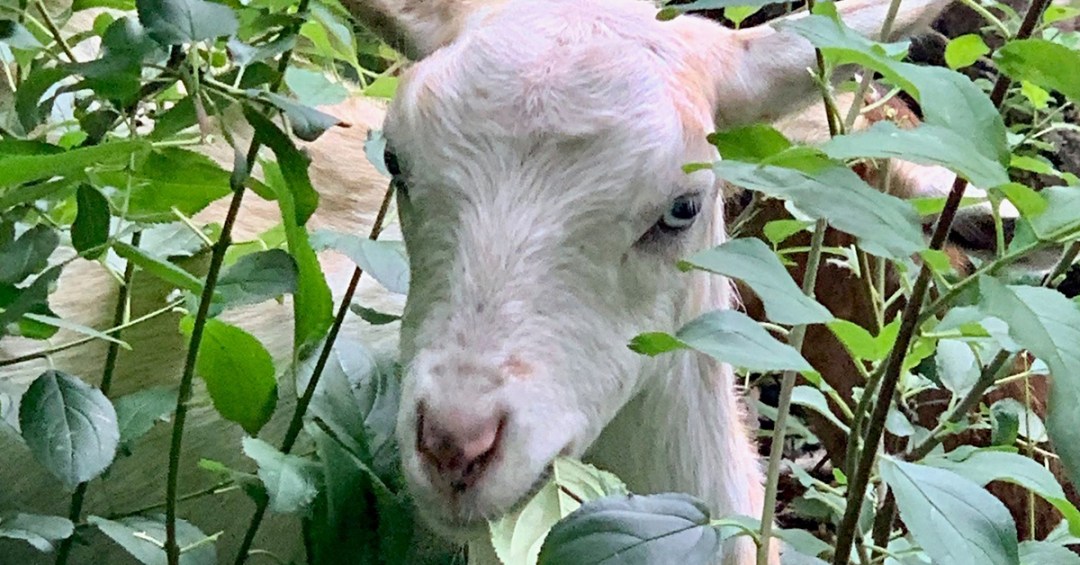
For approximately two weeks in the spring and fall of each year, the goats of Mulberry Lane Farm come to the environmental center. While there, they work to control invasive plant species by eating their way through them. Buckthorn is the largest problem in the conservancy zone due to its long growing season and broad leaves that create ground-level shade. Invasive plants harm native plants by using resources and creating competition. New seedlings of native species are unable to mature while invasive plants continue to spread and take over.
The fall of 2025 was the 15th time the goats grazed upon the buckthorn at 1000 Islands. Throughout the years, the goats have taught the young, the old and everybody in between many important lessons through their work, play, and determination to get the job done. Here are the top 10 lessons the goats have taught us:
#1 Be an Innovator
In 2018, in an effort to control invasive plant species, a dedicated volunteer researched the idea of bringing goats to the nature center. No similar projects existed in the area nor were there others to learn from. Through research and passion, the “Goat Project” was given the blessing by the former Director/Naturalist, Debra Nowak. The first task was developing a “Goat Team” to start brainstorming ideas and that’s when Mulberry Lane Farm came into play.
#2 The Importance of Volunteering
Margaret Mead said, “A small group of thoughtful, committed citizens can change the world; indeed, it’s the only thing that ever has.” Goat Project volunteers are truly priceless and have a passion for teaching others about issues that can be solved in a safe, chemical-free manner.
A core group of volunteers has taken on the “Goat Team” title. Since the fall of 2025, it’s consisted of Farmer Pat and Bonnie, the 1000 Island Environmental Center staff, and a small group of local volunteers who have committed their time, passion for the environment, and love of teaching to the project. They all do the behind-the-scenes work that is needed to make this project a success. Each day when the goats are on-site, the Goat Team tends to the daily farm chores. These include mucking the nighttime enclosure, checking fences, filling water troughs, and moving the goats to their grazing area early in the morning, then back to their nighttime enclosure. They constantly brainstorm new methods to make the project run more efficiently and grow from year to year.
A second group of volunteers known as the “Goat Watchers” are people from the community who sign up for two-hour increments of time throughout the day to walk around with the goats as they graze on the invasive plants. In the spring of 2025, Farmer Pat delivered 24 goats, both adults and kids, to the nature center. The job of the Goat Watchers is to monitor goat behavior, bend branches over for the babies to munch on, and make sure the goats are safe. Families, friends, and community members fill the open spots for a chance to spend a few hours with the four-legged munching machines.
#3 Perseverance
The spring of 2024 was filled with an abundance of storms in Kaukauna. The goats did their jobs in rainy weather for 13 out of the 14 days. One of the days, they needed to stay in their enclosure to stay safe, but they did receive “room service.” Four Goat Team members adorned in raincoats with clippers in hand cleared two wheelbarrows filled with buckthorn and delivered them to the hungry herd.
Some might think the life of a goat is mundane. Their daily schedule really doesn’t vary much during their stay at the center: Nine hours munching and foraging the grounds to rid invasive plants, running up and down the hill as they are moved to and fro from the grazing area to their secure enclosure, meeting new volunteers, having a sleepover with friends, and then doing it all over again. If we learn anything from their daily schedule it is to live in the present moment and find satisfaction in the simplest activities, from sharing a meal with loved ones, playing with buddies, napping, or listening to the rain on a quiet evening.
#4 Importance of “Living a Simple Life”
The simplicity of a goat’s life includes not being a picky eater, spending time outdoors, playing with everyone, helping a friend, and taking care of planet Earth.
Goats do not thrive in isolation. Their mental health and well-being are intertwined with their social bonds. As connections are maintained, goats not only ensure the success of the herd, but they meet their individual needs for security and companionship. Goats remind us that fulfillment can be found in life’s essential pleasures.
#5 The Joy of Play
Goats are renowned for their playfulness. Whether it’s head-butting a friend, climbing on stumps, or climbing trees in their browsing areas, their fun is not merely recreational. This play is an integral part of their cognitive and physical development. As the Mulberry Lane Farm goats incorporate play into their daily lives it becomes a source of joy and well-being for the visitors and team of volunteers. This helps us humans manage stress, smile, and remember that play can be simple.
#6 Herd-Living is the BEST
The life of a goat herd is a model of community living. The citizens that visit 1000 Islands see the goats foraging, resting, and exhibiting a remarkable ability to thrive in their social group. The herd is not just functional as it controls the spread of buckthorn, but it is a deeply harmonized unit where each member plays a vital role in the collective well-being of the herd. Each morning it is easy to identify the leaders as the herd moves. We can also identify the nurturers that stay behind for the Nanny Goat, always keeping up the rear of the pack. The rule breakers want to keep eating even though it’s time to move. The little troublemakers let their personalities shine as they chew on the clothing of the Goat Watchers or show escape-artist skills as they try to gain their independence.
#7 Connecting to the Community
During their two-week stints each spring and fall, the goat herd truly becomes part of the Kaukauna community. The goats become teachers, counselors, environmentalists, and friends to all who visit. St. Paul Elder Services brings community members down to the nature center to learn about the role the goats play in controlling invasive plants. As residents interact with them the goats transform into therapy animals as they’re petted, hugged, whispered to, and loved. Groups schedule their weekly trail walks to be on-site when the goats run down the hill to their browsing areas each morning. Families gather at the end of the day for the moving of the goats. They know the Goat Team will allow short visits in the nighttime enclosure for hugs and an up-close experience with the herd. Farmer Pat once said, “Their time at the environmental center is like a spa vacation for the goats—great greens to eat and lots of human attention!”
#8 Be a Leader as you “Walk the Walk”
Kaukauna High School Environmental Science class members have assisted the project in several ways, including a study of the plants before and after the grazing. Data shows the percentages of various plants eaten. In 2021, high school students, Lilly and Tatum, calculated the percent coverage of different plant species in a random quadrant within a larger study area to determine the efficiency of using goats as biological control against invasive species. The students concluded the goats were very helpful in defoliating buckthorn and ate many other plant species.
Kaukauna High School students published the picture book, Grover, the Goat, written by Maddy Clark and illustrated by Lilly Roehrig. The story is written from the goat’s perspective as he spends two weeks eating buckthorn at 1000 Islands Environmental Center.
The goats of Mulberry Lane Farm have shown us to “Make Everyday Earth Day.” The simplistic life they live lends a hand to take care of the land. There is no “Planet B” and we all need to step up our game plan to do our part—just like our goats.
#9 Be an Environmentalist
Normally the only way to combat buckthorn is through labor-intensive removal of the plants or chemical treatments that not only kill the plant, but find their way to groundwater, streams and rivers. The goat herds that have foraged 1000 Islands Environmental Center ridding invasive plants have shown our community a natural, low-impact way to control buckthorn in the area while keeping our groundwater and waterways chemical free. In recognition of the great work the goats have done in the community, Kaukauna Mayor, Tony Penterman, declared it as “Invasive Species Control Month” in June 2024 in Kaukauna.
#10 There is no I in TEAM
As Helen Keller once said, “Alone we can do so little; together we can do so much.” Mulberry Lane Farm, the 1000 Islands Environmental Center staff, the Goat Team, the Goat Watchers, and the herd of goats are a prime example of how working together is how things get done.
This article was originally published in the September 2025 issue of Appleton Monthly Magazine.