by Holly Boetcher
For passionate gardeners, the debate over whether to divide hostas, coneflowers, and daylilies in the late fall or early spring is a perennial question. In my garden, which hosts plenty of sprawling plants, this decision is a seasonal ritual. As I wander the serene garden nooks, I often find myself mentally mapping out which plants need dividing, and where the gardens will expand next.
A rule of thumb is that perennials should be divided in the spring or fall when the weather is cool. Spring blooming perennials such as astilbe should be divided in the fall, and late blooming perennials such as coneflowers and autumn joy sedum should wait until spring. From experience, I’ve found that dividing hostas in early spring has its perks. The tender buds pushing through the warming earth make the process feel less invasive, and the plants are easier to handle. However, spring division comes with a challenge: remembering the plants’ mature appearance. For gardeners like me, who obsess over creating harmonious contrasts in color, variegation, and shape, this can be tricky.
That’s why I lean toward the fall division camp for my hostas. While it may feel like you’re giving the plant a rough time by damaging leaves and causing setbacks, the payoff is worth it. By the next growing season, the hostas will bounce back, rewarding you with lush, vibrant growth.
Do you have some dividing to do? Here are the tools you will need:
- Wheelbarrow
- Shovel
- Cutting tool (such as a sharp knife or spade)
- Organic matter or compost
Step by Step
- Assess and plan: Identify which plants need dividing.
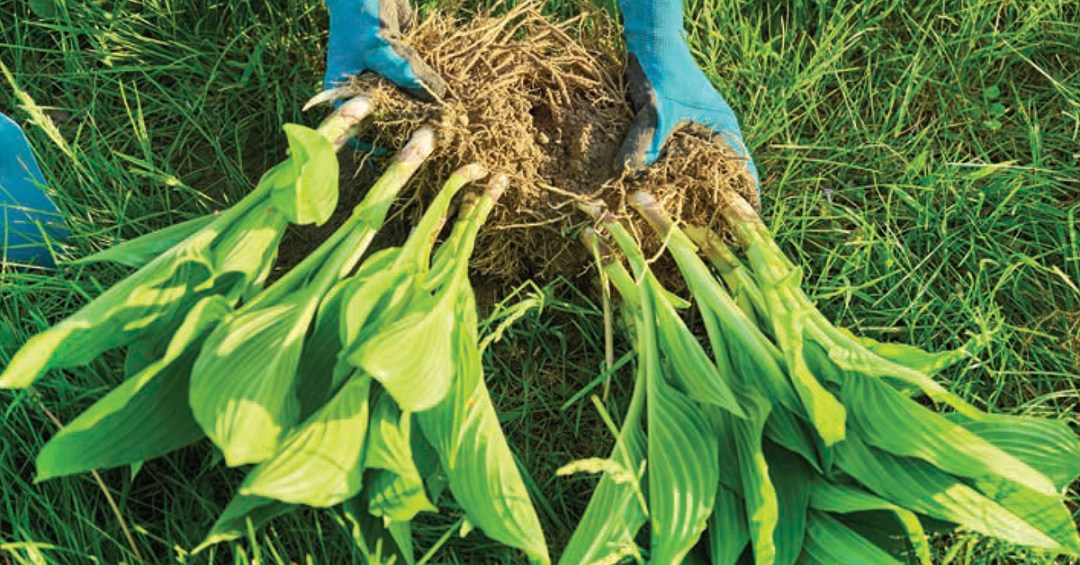
- Digging up the plant: Use a shovel to dig around and beneath, and be careful to preserve as much of the root system as possible.
- Dividing the roots: Use a sharp cutting tool or shovel. I prefer to slice through the root ball with my shovel. Each section should have a healthy portion of roots.
- Replanting:
Original spot: Add organic matter or compost to the hole where the plant was, then replant one of the sections.
New locations: For the other divisions, dig holes twice the size of the root system. Enrich soil with organic matter, place the plant, and fill in around it. - Water generously: After planting, water thoroughly and continue to water regularly to help them establish.
Design Tips
For a polished look, plant as a specimen, or in groups of three or five. Consider adding companion plants. For instance, I pair hostas with astilbe, baptisia, bleeding heart, fianthus, or pulmonaria (lungwort) to enhance the garden’s texture and color.
Patience Pays Off
Dividing perennials may leave them looking a bit bedraggled, but don’t worry. After a restful winter, they’ll emerge in spring more beautiful than ever, ready to steal the show once again in your gardens.
Whether you’re a fall or spring divider, the key is to enjoy the process and look forward to the rewards of a thriving, well- designed garden. Happy gardening!
This article was originally published in the October 2025 issue of Appleton Monthly Magazine.