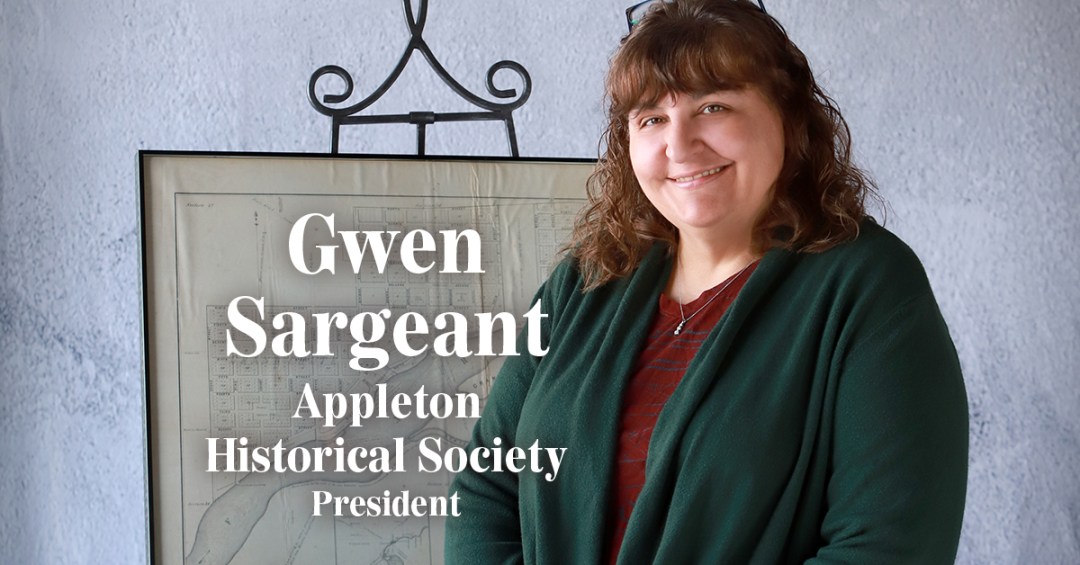
by Tim Froberg
SARGEANT ENJOYS LOOKING BACK AT APPLETON’S HISTORY
Clocks move forward, chewing up precious time with every passing second.
Historians see time differently. They enjoy pushing the clock back and examining people, events, and developments from earlier eras.
Life in the past lane suits Gwen Sargeant just fine. She is the president of the Appleton Historical Society and has been a board member since it was formed in 2011.
Sargeant works diligently to promote and preserve the city’s history. She oversees daily operations, exhibits, artifacts, archives, and presentations of the Appleton History Museum, which is run by the Appleton Historical Society.
Sargeant also manages the historical society’s social media account, leads local history tours, and helped put together a 2015 book titled “Images of America: Appleton.” The book contains rare vintage photos along with detailed stories and anecdotes about the history of Appleton.
Sargeant, who co-owns Appleton Bicycle Shop with her husband, Joe, does her historical work for free. The Appleton Historical Society is an all-volunteer organization.
“History is a passion of mine,” said Sargeant, an Appleton native. “I enjoy all the different stories people bring to the table. Every time we have an event, someone will walk up with a picture, a story, or an artifact that is incredibly interesting. I always learn something new.”
Surprisingly, history wasn’t on Sargeant’s radar when she attended Lawrence University. She graduated from the school in 1997 with a bachelor’s degree in science.
“My degree is actually completely opposite of history,” said Sargeant with a laugh. “I was a science kid, taking classes in biology, physics, and organic chemistry.”
Still, Sargeant was intrigued by history and developed an interest in genealogy, the study and tracing of family lineages.
“What has always grabbed me about history is the depth of different people, families, and businesses that helped build communities,” she said. “There are lots of smaller stories that haven’t been told. I love telling those smaller stories about people who had a small but important part in Appleton’s history.”
APPLETON’S ORIGINS
Sargeant finds Appleton’s history to be particularly intriguing — especially with its direct connection to Lawrence University. She has done considerable research on topics such as Appleton street names, businesses, and early settlers.
According to Sargeant, Appleton was originally named after Sarah Elizabeth Appleton Lawrence. She was the wife of Amos Lawrence, the Boston merchant and abolitionist who founded Lawrence University (then known as Lawrence Institute) in 1847.
At that time, the local area was made up of three unincorporated villages: Appleton, Lawesburg (where much of Lawrence University is currently located), and Grand Chute (where the courthouse stands). The three merged into a single incorporated village in 1853, and it became a city in 1857.
Although one of the three villages was already known as Appleton, it became the town’s official name in hopes of securing a substantial donation from Samuel Appleton, a prominent New England philanthropist and a cousin of Sarah Elizabeth Appleton Lawrence. Samuel Appleton made a $10,000 donation toward the construction of the Lawrence library, and the town was named in his honor.
“One of my favorite parts of Appleton history is the way that Lawrence University is intertwined with Appleton’s history,” said Sargeant. “Lawrence was established in 1847, so that was sort of the beginning of the timeline of Appleton.”
“The very first spots in the city were College Avenue, along with Durkee, Lawrence, and Morrison streets. They were the original corners. The first Lawrence building was in the middle, where the YMCA is.”
EXPLORING HOUDINI AND DAFOE
Sargeant has studied many of the famous names and celebrities who have lived in Appleton, including legendary magician Harry Houdini and Oscar-winning actor Willem Dafoe.
“What I find really interesting about Houdini is that he felt a connection to Appleton despite only being here a few years,” Sargeant said. “I think that’s true of a lot of people that come to Appleton.
“I also find it interesting that he did one of his famous tricks off the Lawe Street Bridge after establishing his career and returning to Appleton. There is a little plaque down on the trail right next to the bridge that mentions that.”
Dafoe is an Appleton native who attended Appleton East High School.
“People who knew him called him Billy ‘Day-foe,’ which is how they pronounced it at the time,” Sargeant said. “He was in a lot of school plays and musicals. A lot of times at the museum, we’ll get donations of (musical or theatrical) programs from those years, and it’s fun paging through them and seeing his name. It will say, Billy Dafoe. He didn’t go by Willem at that time.”
KATE BLOOD’S URBAN LEGEND
Another famous Appleton name that Sargeant has studied is Kate Blood, who has been a bit of an urban legend for years. Blood was falsely rumored to be a witch and axe murderer in the 1800s who killed her husband and children. Legend has it that blood has been known to ooze from her tombstone at Appleton’s Riverside Cemetery, making her grave a popular site for visitors, especially around Halloween.
“Her name gets mentioned in a negative way, but there’s no truth to any of that,” Sargeant said. “All that talk of her being an axe murderer and everything, it’s a myth. A lot of it comes from the fact that her tombstone says Blood on it. Well, that was her maiden name. The myth that her tombstone bleeds – that could be more related to something like a post on her grave having rust on it.”
Sargeant’s findings run completely opposite to the chilling urban legend stories about Blood. Sargeant says that Kate Blood was the daughter of one of Appleton’s earliest pioneers, Capt. Henry Blood. She lost a child due to illness and died in 1874 of tuberculosis at the young age of 23.
“She was by all accounts, one of the fairest maidens — as they used to say back then — of Appleton,” Sargeant said. “She was a kind, wonderful woman. Her story is tragic, but none of the myths and legends which put her in a negative light are true.
“She had a daughter who went on to write some books that are still used today. So she actually has kind of a neat legacy in her family.”
BIKING THROUGH HISTORY
Even as a business owner, Sargeant finds herself dealing with history. She owns the oldest bike shop in the city. Clarence Hinzman, Gwen’s grandfather, opened Appleton Bicycle Shop in 1939, and it has remained in the family for the past 87 years. Her father, Paul, has been an owner.
“My grandpa used to ride this big high wheeler in Appleton parades,” Sargeant said. “I find that pretty neat because it’s not so easy to hop on one of those and ride it. Our bike shop has a history of its own. People come in and tell me stories about the bike they bought here in the 1970s or how they used to work here in the sixties. It’s all so fascinating.”
One of Sargeant’s favorite activities combines her two passions. She leads a biannual moonlight bicycle history tour for the Appleton Historical Society. It is a free event, and the next one is scheduled for May 14 at 6 p.m., with riders meeting at the Appleton History Museum.
Sargeant and other historical society volunteers are enjoying the museum’s new location, which opened in 2024 and offers almost three times as much space as the former Durkee Street site. Sargeant played a key role in a $1.5 million capital campaign to purchase and renovate the museum.
The Appleton History Museum features both permanent and rotating exhibits. The permanent exhibits include the Atlas Paper Mill, a former Kimberly-Clark paper production site that ran from 1878-1999; the Courtney Woolen Mill, once a staple for producing wool and polyester batting for quilts and blankets, which closed in 2024 after an amazing 144-year run; the Gloudemans-Gage Lamson Preferred Cable Cash Carrier, an overhead cable-carrier device that once allowed clerks to transport sales slips and money to storage in small metal boxes and was considered cutting-edge retail technology in the 1930s; the David L. and Rita E. Nelson Map Gallery; and the Claudine and Jim Happel Fireside Library.
The current rotating exhibits include Made in Appleton, which showcases the city’s’ industrial and manufacturing heritage; the Mary Beth Nienhaus Sports History Gallery, which is currently focusing on football and examines Appleton gridiron greats such as former NFL star and Super Bowl winner Rocky Bleier; Presto Products; Air Wisconsin; Trolleys; the Dave Kalz photo collections; and Reverence: The History of the Makaroff School of Ballet.
“We have a lot of interesting things to see and do,” said Sargeant. “I love the cable cash carrier and watching it zip across the museum. The map room is really a delight because it allows you to see how the city developed in size over the years.
“My favorite part is the Claudine and Jim Happel Fireside Library. It has so many different resources, directories, history books, and personal stories.”
When she’s not dealing with her business or historical matters, Sargeant enjoys family time with Joe and their children: Joey, 22; Helen, 21; and Auggie, 19.
This article was originally published in the April 2026 issue of Appleton Monthly Magazine.