by Tim Froberg
MCRAE’S LIFE DEDICATED TOWARD HELPING ANIMALS
Michelle McRae’s passion for helping animals goes back to her childhood.
She was basically a one-person animal hospital and sanctuary.
“When I was a little girl, I brought everything home,” said McRae. “If I saw something hurt or injured by the side of the road, I’d bring it home and take care of it. We had a spare room where I had cages for all the critters I brought home. There were birds, gerbils, guinea pigs, bunnies, everything you can imagine.”
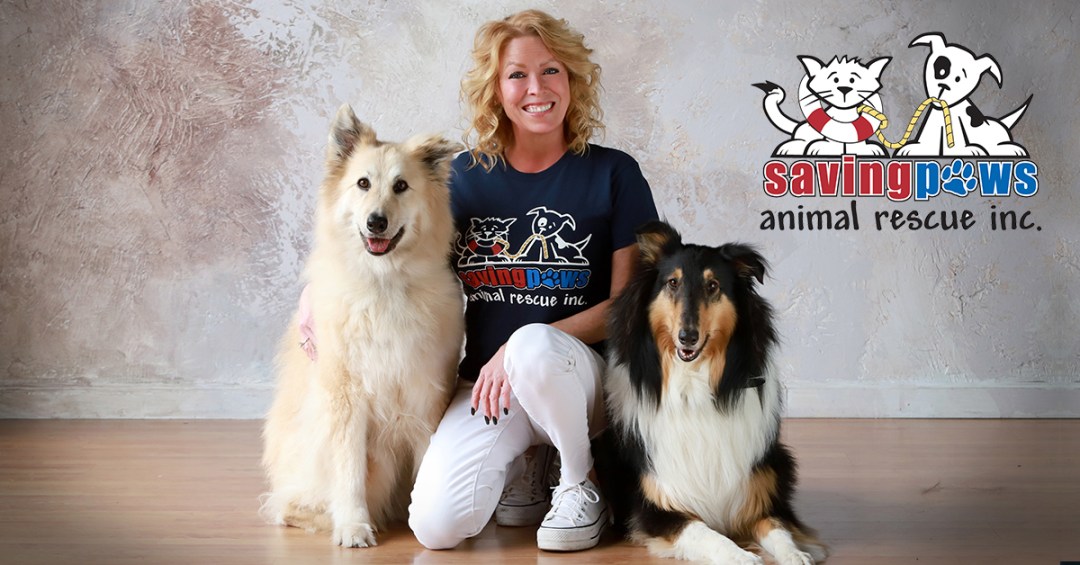
McRae never lost her love of animals or her strong desire to care for them. She and Elizabeth “Betsy” Moder are the founders and operators of Savings Paws Animal Rescue Inc., a nonprofit, volunteer-run, no-kill rescue dedicated to rescuing and rehoming homeless, abandoned, and special needs animals.
Saving Paws is located in Appleton at N3141 Meade St., directly across from McRae’s house, and focuses on assisting dogs and cats of various breeds and mixes. It has a recently constructed building for canines and another for cats. Saving Paws relies on its dedicated volunteers and is funded by donations to provide care, veterinary attention, and shelter space for animals.
Saving Paws has an impressive adoption rate, especially for dogs. It is involved with two transfers each month that bring 15 to 25 dogs from Texas and Tennessee to Saving Paws. Transferring rescue dogs involves relocating them from overcrowded high-kill shelters, often in southern states, to shelters such as Saving Paws with more resources and higher adoption rates. Volunteers typically transport the dogs in vans.
“It’s hard to give a number for the dogs we have because they’re often going out (to foster and permanent homes) just as quickly as they’re coming in,” McRae said. “Most are either adopted right away, or they go into foster homes because they’ve already been vetted, seen doctors, and many of the adopters have been pre-approved.
“So they’re rarely with us for a long time. They’re all dogs that are going to be euthanized if we don’t take them.
“We work with wonderful rescues. The Texas rescue drives them all the way to us, while the one in Tennessee, we’ll meet them in Madison or Chicago. They’re so grateful that we’re helping them out.”
Saving Paws’ cats reside in separate rooms in the rescue’s main building.
“We’re no-kill, so everything that comes to us, we deal with it,” McRae said. “That can get a little tricky, especially with cats, because you get cats with diseases or digestive problems. Or maybe they’re picky eaters, or there are age differences among them. That’s why we turned the main house into a cat building and why we put our cats in separate rooms.”
Saving Paws actually started in McRae’s garage. She had been rescuing, caring for and providing sanctuary to unwanted animals for several years — and doing it out of pocket. Moder had been doing the same thing when she met McRae at an area veterinary clinic where they had both taken rescue animals for treatment. The two quickly discovered they shared a common love for helping animals and formed Saving Paws, which became a nonprofit in 2006.
“I had been doing this on my own for quite a while, and so had Betsy,” said McRae. “My husband (Dennis) said, “This is getting expensive. You need to go nonprofit. That way you can save more animals.’ Betsy is the number one reason, along with our volunteers, why Saving Paws is what it is today.”
McRae and Moder had helped various types of animals prior to the creation of Saving Paws, but decided to focus on cats and dogs.
“Before we went nonprofit, I had rehomed pigs, hedgehogs, horses, birds, reptiles, all kinds of critters,” said McRae. “We just didn’t have the space for larger animals, and other rescues for birds and reptiles had formed. So we knew they were getting the help they needed.”
When asked if she had a particularly memorable rescue story, McRae had a tough time pinning down a favorite because she had several. Here are three of her personal favorites.
A MAJOR CHALLENGE
Prior to launching Saving Paws when she was rescuing animals on her own, McRae was able to find permanent homes for six horses, two of which were blind, which made rehoming them very challenging.
“It was two different situations and both horses were completely blind,” she said. “Finding them their forever homes was a little tricky because in both situations we had to find a horse they connected with and who they could follow. But we did it and that was beyond heartwarming.”
TAKING A CHANCE
Another Saving Paws success story involved a sweet, affectionate domestic short-hair tiger cat named Chance, who was found in Little Chute during the winter months behind a cheese factory.
Saving Paws took Chance in and scanned him for a microchip. It was learned that he was 6 years old, but the owner’s phone number had been disconnected. Saving Paws took Chance to an urgent care veterinary clinic to treat a badly injured leg and Chance eventually needed surgery to amputate the leg.
Saving Paws was able to raise enough money to help with Chance’s medical bills and he healed and became a Saving Paws feline resident. However, his bad luck continued when Chance tested positive for FeLV, also known as feline leukemia virus. It is a contagious retrovirus that weakens animals’ immune system, making them vulnerable to infections, anemia and cancer.
It was later learned that Chance had regressive FeLV. That was great news considering it meant the virus was minimal in his blood and could be controlled by his immune system, giving him a good chance to live a normal life.
Still, McRae wondered if Saving Paws, with Chance’s medical history, would be able to find a forever home for him.
“We were still concerned that his adoption would be difficult due to his needing to be with other cats that also tested positive for FeLV, or be the only cat,” McRae said. “Plus most people are scared off when they hear of FeLV.”
But one person wasn’t.
“Within a week of being available, we received applications for Chance,” McRae said. “One application stood out and we did a meet-and-greet with him. The visit went perfectly and Chance was adopted.
“We went over Chance’s medical history with him and explained everything. Chance’s new owner had already researched FeLV and was OK with it. He wanted to give a hard-to-adopt-cat a home. We’re excited to say that Chance went to his new home and is doing well.”
FINDING A HOME FOR FLOUNDER
And then there was Flounder, a female Labrador mix who was born at Saving Paws and bottle fed as a young pup because she came from such a large litter. Flounder was diagnosed as a pup with pulmonary stenosis, a congenital heart condition characterized by the detection of heart murmurs that can be fatal if left untreated. She needed to have routine checkups for a year before she could have surgery, which was essential toward saving her life, and her impending surgery delayed her adoption.
Flounder, though, had a foster mom, Robin Fisher, who routinely took Flounder to Madison for the checkups and the January surgery. Saving Paws raised roughly $7,000 through fundraisers to pay for Flounder’s operation which was a major success.
“Robin is now her adoptive mom and says she is doing wonderful,” said McRae. “She helped her through this whole journey, so of course, she had to adopt her. She says that Flounder is submissive, young, wild, and quite the character. She’s even thinking of training her to be a therapy dog.”
What McRae also finds heartwarming is the dedication of the 150 to 200 volunteers who help keep Saving Paws alive.
“Oh my goodness, we have a wonderful, amazing group of volunteers,” McRae said. “I can’t tell you how important they are. This whole organization runs because of them. Some come here every day, others come every week. We have volunteers who have been with us since the beginning. They’re just so compassionate and love animals so much.”
A COMPASSION FOR ANIMALS
McRae is an Appleton native, who grew up on Franklin Street near City Park. Her family owned three cats and a dog throughout most of her childhood – not counting the animals Michelle would bring home.
“I feel the reason the good Lord put me here is to help animals,” she said. “Anything that was wounded, injured, or homeless, I would bring home. My dad would always take me to Bubolz Nature Center to rehabilitate injured animals that I picked up. If it was a dog or cat, we usually would bring it to humane society, but we did end up keeping a few. This has always kind of been in my blood.”
Saving Paws is very active with social media and regularly hosts events to raise money for the rescue.
“Every time we host an event, we seem to attract an adopter or a volunteer,” McRae said. “They’re huge.”
McRae doesn’t say goodbye to pets when the rescue get locked at night. She and Dennis, who have been married 25 years, own two dogs, Macy (a Great Pyrenees mix) and Moose (a Collie) along with a cat, Ash (a Chinchilla Persian). The couple has two boys, Quintin, 16, and Dain, 13.
“The boys help out with the rescue a lot,” said McRae. “They help mom with the dirty work.”
To adopt a cat or dog, volunteer, or make a food, toy, or financial donation with Saving Paws, go to the organization’s website, savingpaws.com. The group can also be emailed at info@savingpawswi.com.
This article was originally published in the May 2026 issue of Appleton Monthly Magazine.